Mali is one of the poorest countries in the world. Its people is famous for their generous hospitality and their love for music and soccer. Mali has been under conflict for more than a year, after an ethnic Tuareg uprising in the north caused a soldier rebellion in the south that overthrew the government. The Tuareg rebels supported by a coalition of jihadist fighters took the North of the country, terrorizing with a sharia law the moderate people of Mali and almost splitting the country in two, causing a humanitarian catastrophe, with massive displacements and refugees fleeing to nearby countries and to the capital, Bamako, in the south. In January, a French-led intervention liberated the north of the country. 7/28/13 marked the elections to re-established some democratic order.

Showing posts with label Mopti. Show all posts

Thursday, June 6, 2013

The no-road to Timbuktu

We’re finally allowed to cross the internal border from Southern Mali to Northern Mali.

The crisis started in March of 2012 when a loose coalition of rebel movements threw out the official Mali State from Northern Mali. 

The alliance of groups such as al-Qa`ida in the Islamic Maghreb (AQIM), Ansar Eddine, and the Movement for Unity and Jihad in West Africa (MUJAO) managed in the following months to take town after town, all the way to Konna, only 100 miles north of Mopti, the hinge that separates north and south.

This advance prompted the intervention of 4,000 strong French troops. We don’t need to follow the news or the maps to know where we are. Every few meters we find cars and trucks that apparently were bombed by the French while the jihadist were trying to retreat back north.


Oumar, our driver, shows us on the side of the road the bombed truck that the jihadist had taken from a local business to carry the bodies of death rebels. Almost as disturbing, on the side of that truck, we find a pile of bombs from the French air-strikes. 


We also see a bombed jihadist training camp.


From March 2012 to the French liberation in January of 2013, the legendary Timbuktu was victimized by these fundamentalist groups, that imposed a strict Sharia law, including killings, amputations, and other atrocities. We’re traveling by road to Timbuktu, on a humanitarian mission to establish the needs of the local hospital. Apparently, the few foreigners that have visited Timbuktu since the liberation, mainly journalists and a humanitarian first responders, have traveled by air, but the airport is now close and it’s impossible to get on the limited flights. (The multinational mission from the UN will not officially land in Timbuktu until July 1st.)

As we drive north, we’re also getting closer to the dessert. The strong, hot winds are so sandy, it looks cloudy. It’s about 107 Fahrenheit, 42 Celsius. The landscape is drier and the density of population has fallen dramatically. We finally reach Douentza, a town on the skirts of some beautiful rocky mountains. 


And here is where the most dangerous part of the ride starts. To go from Douentza to Timbuktu, we must drive 195 kms (120 miles) through something that resembles more a path than a road. 


The photos don’t do justice to how bad the path actually is, because we didn’t think it was safe to stop to take video or photos, and we couldn’t risk to waste a minute and arrive too late to Timbuktu. But most importantly, the path to Timbuktu is deserted and too wide-open, and we have been warned against bandits and the possibility of kidnappings.  Our man in Mali cautions: “No matter what happens, we can’t stop, for nothing, for nobody.”

We were warned also that the “road was not good”. I would call that the understatement of the year. Considering that for many refugees and displaced people from Timbuktu, this was the only way out, or back, makes my heart sink. 
For the first 100 kms (60 miles) we don’t see anything or anybody, other than another 4X4 from the Red Cross driven by one Malian man. No people, animals or cars. The isolation of Timbuktu becomes more and more clear.

Our 4X4 barely can make it on this road. Last night, it rained, which made the soil more dangerous and unpredictable. We have a couple of near misses. One in particular is pretty scary: we have to speed and jump over a bump that was much higher than expected on the other side. We have a dramatic landing, but we’re not hurt. We inspect the car and it seems to be OK. Needless to say, this is the last place on Earth where we need to be with a broke-down car.
Half way down the road, we encounter semi-abandoned mud villages and we see people for the first time since Douentza. The worse of the trip is yet to come in the second half. We run into several trucks and vans stranded in the muddy potholes, or with destroyed tires. The vehicles seem to be driving back displaced people. There are also some abandoned cars of people who never made it.

We finally get to the Niger River. Timbuktu is on the other side of the river. There is no bridge. “The no-road to Timbuktu” followed by “the no-bridge to Timbuktu”. 

We understand now the frustration of the people in Northern Mali, while in the South, the Capital Bamako spends millions in infrastructure projects: highways, parks, bridges… many of the towns in the North continue to be isolated, even those with the strategic, historical and potential touristic importance of Timbuktu.


We will have to wait two hours until the next ferry to cross the river. We are now at the receiving end of the famous Malian hospitality, in one of the tents, we discover something of a local restaurant, a place to eat and rest. We eat with our hands some fish and lamb innards. Those who miss the last ferry to Timbuktu can also spend the night in these tents. People are happy to see us. Maybe they think our presence is a sign that things will soon return to normal.

The owner of the tent tells us how hard is to even survive. Practically, no vehicles are coming this way anymore. In Songoy, one of the local languages, he tells us about the atrocities committed by the jihadists. I record the interview. Almoustafa will translate for me later. For now, all I need to understand doesn’t require words: the sadness in his eyes and his profound sense of desperation.


Monday, June 3, 2013

Our head in the lion’s mouth

Today, we left the relative “quiet and peace” of Bamako, the capital of Mali, to travel north, to a land banned for security reasons to practically all foreign visitors.  By all accounts, going north, only four months after the French military intervention aga'sinst the jihadist rebels started, is a difficult and dangerous enterprise.  Four months is not a long time to create the secure conditions to start the rebuilding process in a country with limited resources, suffering a devastating economic crisis and a lack of basic infrastructure: safe roads, for one. The UN support troops will not arrive until July 1st. 


We are going on a medical, humanitarian mission to the legendary Timbuktu. 

We will be driving through the very unstable areas that French and Malian troops liberated from rebel Tuareg and their Taliban-minded partners. The government of France has declared this area a no-travel Red Zone. 

An estimated ninety percent of Malians are Muslim. This country has been long recognized as a model for tolerant Islam. The state is officially secular and the constitution protects the freedom of religion. The pride Malians take in their religious tolerance made the abuses perpetrated by the fundamentalists even more shocking: killings, amputations, secret and public beatings and destruction of art and monuments, all in the name of Allah.

I’m traveling with Dr. Robert Murphy, founder of the International AIDS Education Project. He is also a faculty member at Northwestern University, and the director of its prestigious Center for Global Health. The goal is to assess the damage caused by the conflict to the local hospital and how support could be expedited to help the health delivery system of the remote Timbuktu. 

No matter how needed and welcomed Dr. Murphy’s help may be… somehow, we could also become a thorn in the side of the authorities, both national and international. The last thing authorities need in preparation for the now official elections July 28th, would be something happening to two US citizens in Mali. Being from the West and white makes it even more difficult for both of us to travel inconspicuously.

The nightmare scenario would be a kidnapping. We’re being told that the danger is not only to be kidnaped by an Al-Qaida affiliated group, but also to be kidnapped by any thugs or sympathizer who could sell us to Al-Qaida. Unfortunately, in a situation like this, the ransom for a US citizen could be a coveted price.

During the last two years the north of Mali has witnessed some extremely dramatic killings and kidnappings of western visitors. Last year, four tourists were kidnapped gunpoint from a restaurant, when one of the tourists refused to enter the kidnapper’s van, he was shot on the spot. An artist from the UK delivering a truck full of books for the kids of Timbuktu was also kidnapped. According to the US State Department: “On November 20, 2012, a French citizen was kidnapped (…) and terrorist groups have stepped up their rhetoric calling for additional attacks or kidnapping attempts on westerners (…)”

And kidnapping is not the only serious risk ahead of us.

On the plane to Bamako, an employee of the United Nations told me that there is a growing fear of Al-Qaida sleeper cells in Mali, car-bombs or unrest north of Mopti, the city considered the hinge between the south and the north.  And that is precisely our next stop:  Mopti, the Venice of Mali, the town that the rebels were very close to take over, only a few months ago. But first, we have ahead of us 625 kilometers, on treacherous roads. 

Although there are plenty of reasons to be concerned about this trip, Dr. Murphy feels confident that the residents of Northern Mali will welcome and protect us. His long experience working in Nigeria, Uganda, Kenya, and South Africa, among many other countries, is always reassuring.

There are two additional and very important encouraging factors for both of us: Almoustapha and Omar.

Almoustapha Maiga, a PhD virologist and pharmacist from the University of Bamako.  Almoustapha is our man in Mali. He speaks English, French (the official language), Bambara (the main language of the south) and Songoy (the main language of the north). His expertise as a medical researcher and his language skills will be essential for Dr. Murphy to complete his humanitarian mission successfully, and for all of us to return to Bamako safely. 


Almoustapha Maiga, our man in Mali


We also have with us Omar, a very stern and quiet driver who knows the roads like nobody does. He has been driving people across Mali since 1980. He drives us in a 13 year old blue four wheel drive Toyota Land Cruiser. The vehicle has “only” 443,000 kms on it. That is 275,000 miles.

The goal is to get as close as possible to Mopti before night falls. The roads have so many holes and bumps that it is and actually dangerous driving, and adding to that hazard are the hundreds of cows, goats, sheep and people that wander into the driving lanes all day and night long.      

The pavement is very uneven. At times, Omar has to drive half way on the shattered pavement, half way on the dirt shoulder, often located 6 inches or more lower than the hardtop. I have a sinking feeling that the driving conditions may be as dangerous for us as Al Qaida.


The road-trip of a lifetime

On a map, Mali looks like a tilted bowtie. Mopti is precisely the knot on that bowtie, the point that separates south and north. The lower side of the bowtie has greener landscapes, the capital Bamko and the center of power of a majority who speaks Bambara. The upper side of the bowtie is a very large area about the size of France inhabited by an increasingly alienated population, who speak Songoy and Tamasheq and live in an area colliding with the south side of Sahara desert.

Northern Mali covers 66% of the national territory but its population accounts for only 9% of the total population. 
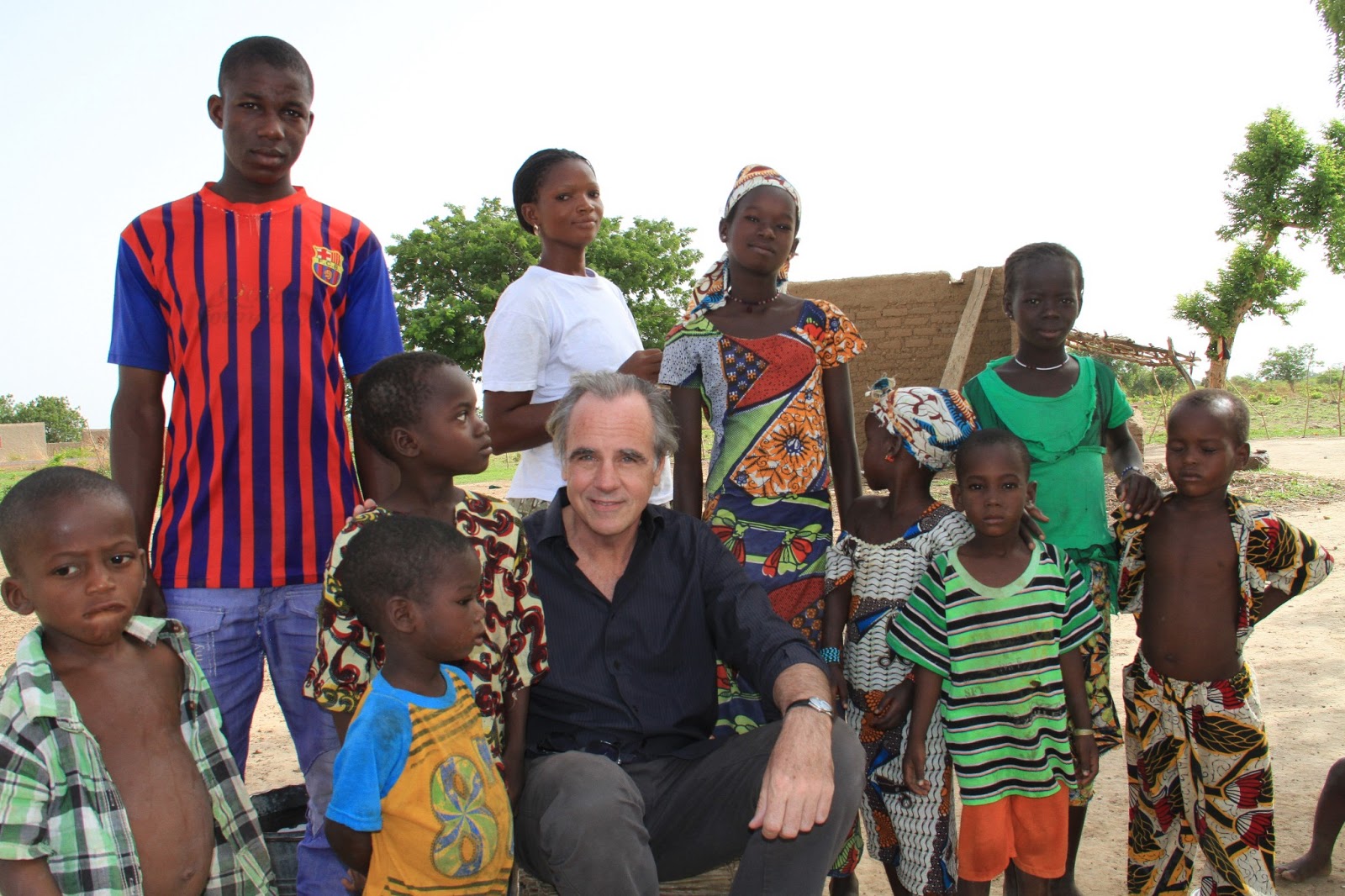
Every other kilometer, we find another little village with sheds made of mud.  They remind me of the Christmas nativity sets I grew up with in Spain. In one of the villages, we pay a visit to the locals. 


Dr. Murphy and my camera are welcomed with great enthusiasm. Dr. Murphy notices a skin infection in the scalp of one of the babies, and leaves behind a prescription for his mother, and money to buy the medicine. 


The villagers send us off, laughing and cheering.


 A couple of villages along the road celebrate colorful local markets. People from nearby villages gather in the market to sell, trade and meet with others. 


The markets along the way


We stop in one post and at a butcher, Almoustapha buys lamb for his brother in Segou, another of our stops along the way.


A visit to the butcher


Mangos are in season, and women dressed in bright, traditional dresses sell fruit on the side of the road. The people of Mali are stunningly beautiful and friendly. And the landscape is breathtaking, too. 


Between villages, you see the magnitude of this flat, endless land. We are still south, and the landscape is not quite as deserted as we are expecting it to be up north.  The most common trees are the balanzan, as the rest of the country, they’re huge, beautiful and haunting.


(For security reasons, these blogs are not being posted in real time)